AI Agents Explained: How They Work and Where They Fail
Everyone’s agreed on the headline: AI agents are the next big thing. I’m less certain they’re telling you the truth about what that actually means.
The way agents get described in 2026, you’d think they’re autonomous systems that you hand a goal and they go handle it, perfectly, indefinitely. That’s not quite what they are. What they actually are is more interesting and more limited than the hype suggests, and understanding the difference matters a lot if you’re trying to figure out whether agents belong in something you’re building.
This post explains how agents actually work, what the research behind them showed, and the specific ways they still break that nobody in the product demos is going to tell you about.
Table of Contents
What an AI Agent Actually Is (Not What the Marketing Says)
The definition that holds up is a simple one: an AI agent is a system that perceives its environment, makes decisions, and takes actions to achieve a goal, without requiring human approval at every step.
Definition: An AI agent is a goal-directed system built on a language model that perceives inputs, generates plans, executes actions using available tools, and repeats this loop until a task is complete. What separates an agent from a standard model call is the loop: agents act, observe the result, and adjust, rather than generating a single response and stopping.
That last sentence is what most explanations gloss over. A chatbot produces a response. An agent produces an action, sees what happens, and decides what to do next based on that. The loop is the whole thing. Without it, you just have a fancier prompt.
It’s worth being clear that “AI agent” isn’t a specific piece of technology. It’s a design pattern. You’re building a loop around a language model and giving it ways to interact with the world. The language model provides the reasoning. The tools provide the ability to act.
How AI Agents Work: The Four Components That Matter
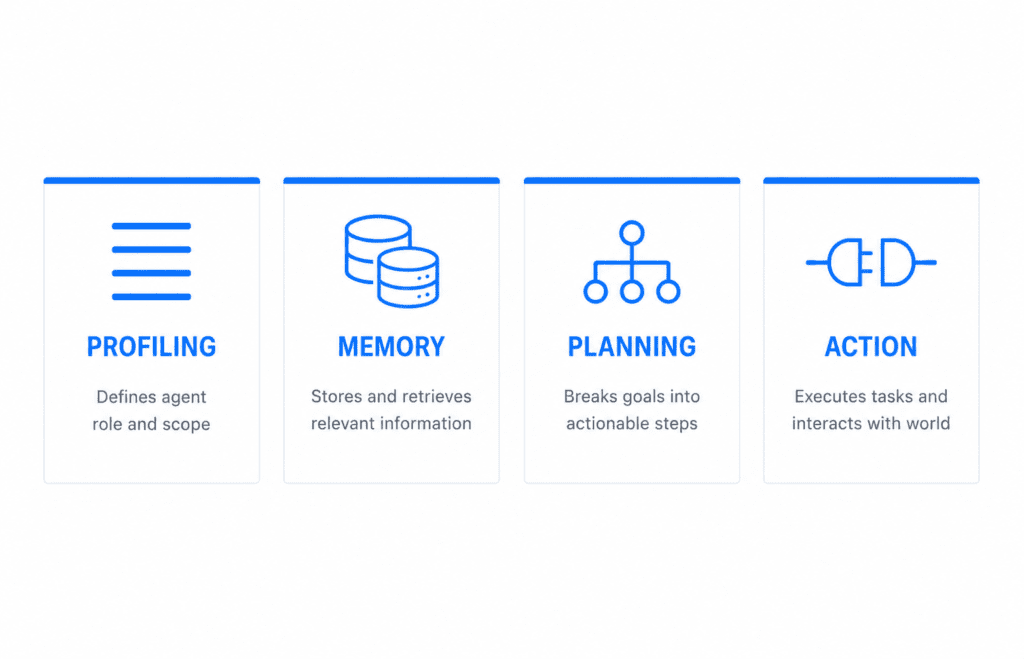
Research from Wang et al. (2024) surveying the field of autonomous agents identified four core components that appear in nearly every working agent architecture: profiling, memory, planning, and action. These aren’t arbitrary, and understanding what each one does is the fastest way to understand why agents are built the way they are.
Profiling is the system prompt layer. It defines what the agent is supposed to be, what it can do, what its constraints are, and what success looks like. A poorly written profile is one of the most common reasons a well-architected agent produces garbage output. I’ve spent more time debugging system prompts than I’d like to admit.
Memory is split into two types in practice. In-context memory is everything in the active context window, including the task, the conversation history, and the results of previous actions. External memory is anything the agent retrieves from outside itself, databases, vector stores, previous session logs. For anything longer than a short task, in-context memory fills up fast. That’s why agents that handle genuinely long tasks almost always need external memory attached. The RAG post on this site covers the retrieval mechanics in depth if you want to go further on that specific part.
Planning is where agents decide what to do next. Simple agents use a single-step plan. More capable agents break a goal into subtasks, estimate dependencies, execute in order, and revise the plan when something doesn’t work. The planning quality is almost entirely a function of the underlying model, which means model selection matters here more than it does for simple completion tasks.
Action is the actual interface with the world: calling APIs, running code, reading files, writing to databases, searching the web. This is what makes tool use the most consequential part of agent design. An agent that can only reason is just a chatbot. An agent with well-chosen tools can actually finish tasks.
The Proven ReAct Framework: Why Interleaving Reasoning and Acting Changes Everything
Here’s what the research actually showed, and why it’s worth knowing.
Before 2022, the two main ways to improve what a language model could do were chain-of-thought prompting (get the model to reason step by step) and action generation (get the model to produce a sequence of actions). Researchers treated these as separate problems.
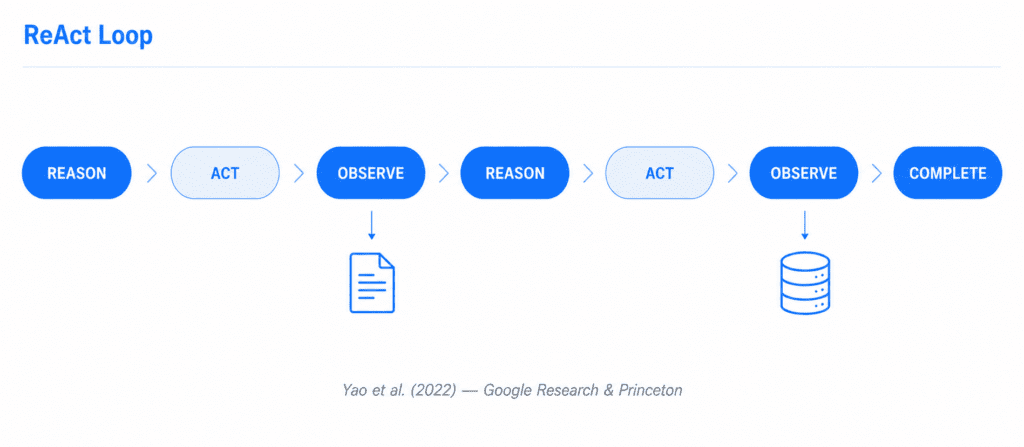
Yao et al. (2022) at Google Research and Princeton published the ReAct framework, which interleaves reasoning traces and actions in the same generation loop. The model doesn’t reason completely and then act. It thinks a bit, acts, observes the result, thinks about what it just saw, acts again. Reason and act alternate, each step informed by the previous one.
The abstract explains this precisely: reasoning traces help the model “induce, track, and update action plans as well as handle exceptions, while actions allow it to interface with external sources, such as knowledge bases or environments, to gather additional information.” What this solved in practice was error propagation. With pure chain-of-thought, one wrong reasoning step compounds through all subsequent steps and you arrive at a confidently wrong answer. ReAct breaks that chain by injecting real-world observations between reasoning steps, which corrects errors as they happen rather than letting them accumulate.
The results they reported were significant. On interactive decision-making benchmarks (ALFWorld and WebShop), ReAct outperformed imitation and reinforcement learning methods by an absolute success rate of 34% and 10% respectively, using only one or two in-context examples. On question-answering and fact verification tasks, it outperformed chain-of-thought alone by grounding reasoning in retrieved facts rather than the model’s internal knowledge.
You can read the paper itself at arxiv.org/abs/2210.03629. The practical takeaway is this: every serious agent framework you’ll encounter today, LangChain, LlamaIndex, AutoGen, all of them, uses some variant of ReAct or an architecture directly descended from it. Understanding the core idea makes the frameworks much less mysterious.
The Multi-Agent Layer: When One Agent Isn’t Enough
Single agents hit limits quickly on complex tasks. A single agent trying to write a research report, check facts, format output, and manage citations at the same time will either exceed its context window or start mixing up which task it’s on. This is where multi-agent systems come in.
The basic idea is specialization. Rather than one agent trying to do everything, you have a set of agents each responsible for a narrow function, coordinated by an orchestrating layer. Wu et al. (2023) introduced AutoGen, which formalized this pattern as a conversation framework where agents with different capabilities communicate to complete tasks that would overwhelm any single one.
What research on multi-agent collaboration found was somewhat unexpected: social behaviors emerge autonomously in agent groups. Agents develop communication patterns, defer to agents with relevant tools, and in some cases exhibit what looks like negotiation about how to divide subtasks. This wasn’t programmed. It emerged from the structure of the task and the agents’ profiles.
LLM orchestration at the multi-agent level is genuinely hairy to get right, though. You have token costs multiplying across every agent call. You have error propagation not just within one agent’s reasoning loop but across agents passing information to each other. And you have the feedback loop problem: when Agent A’s output is the input to Agent B, and Agent B’s output feeds back to Agent A, you need careful guardrails to prevent circular reasoning where both agents reinforce each other’s wrong assumptions.
The LangChain vs LlamaIndex comparison post goes into how these frameworks handle multi-agent coordination differently, if you’re deciding which to build with.
What Nobody’s Telling You About Where Agents Actually Break
This is the section that actually matters for you if you’re considering building with agents rather than just reading about them.
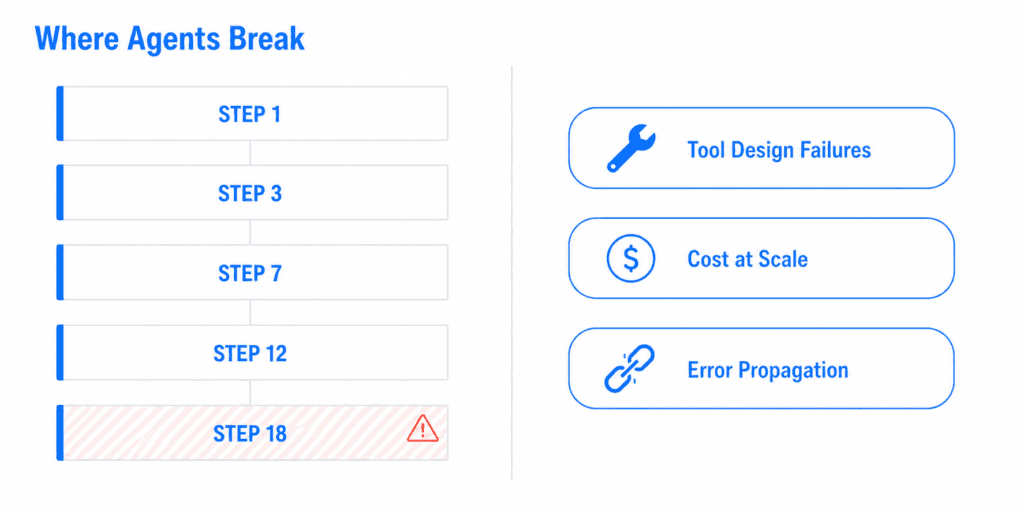
Long tasks degrade. Agents are reliable on short, well-defined tasks with clear success criteria. As task length increases, error accumulation becomes a real problem. Each action has some probability of being slightly wrong. Those errors compound through subsequent reasoning steps. I ran an agent on a research task once that I estimated would take 12 steps. By step 18, it had lost track of two of its sub-goals and started producing outputs that contradicted its earlier findings. The ReAct loop doesn’t fully solve this, it only slows the degradation.
Tool design is most of the work. Most of the time you spend building a real agent isn’t building the agent, it’s designing and debugging its tools. A tool that returns data in an ambiguous format will confuse the agent’s reasoning. A tool that fails silently will cause the agent to proceed with incorrect assumptions. A tool with too broad a scope will cause the agent to call it when it shouldn’t. Getting this right is genuinely painful work and it doesn’t get enough attention in the tutorials.
Cost at scale is non-trivial. An agent making 20 API calls per task, each with a full context window in the prompt, is expensive. At small scale, fine. At production scale, the cost structure of agentic systems is completely different from standard model inference. Teams that don’t plan for this get surprised. The vector databases post is relevant here too, because one way to reduce context-window calls is to retrieve only what’s needed rather than loading everything into every prompt.
Actually, let me rephrase something I said earlier. I called multi-agent error propagation a “feedback loop problem.” That’s imprecise. The real issue is that agents treat other agents’ outputs as ground truth. When Agent B receives a response from Agent A, it doesn’t verify it, it builds on it. So an error from Agent A propagates not just as a wrong answer but as a wrong premise that shapes all of Agent B’s subsequent reasoning. That’s a different failure mode, and it’s messier to detect.
Hallucination doesn’t disappear. Agents that can search and retrieve are less prone to hallucination than agents working from internal knowledge alone, but they don’t eliminate it. An agent can retrieve the wrong document, misread a table, or blend two retrieved facts in a way that creates a new inaccuracy. If your use case requires factual accuracy, pair your agent with explicit verification steps. The hallucination post covers evaluation strategies for this in more depth.
Where Agents Actually Help in 2026 (and Where They Don’t)
Good fit: tasks that are repetitive, multi-step, and have clear completion criteria. Code generation with testing loops. Research summarization with citation checking. Data pipeline construction and testing. Customer support triage where most decisions are rule-like. These are places where the agent’s ability to iterate and correct itself pays off.
Poor fit: tasks that require novel judgment, interpersonal nuance, physical presence, or creative work where the evaluation criteria are subjective. Also anything where errors are catastrophic and irreversible. An agent making database writes without human review is an incident waiting to happen. Agents work best when their actions are either reversible or cheap to verify before they’re committed.
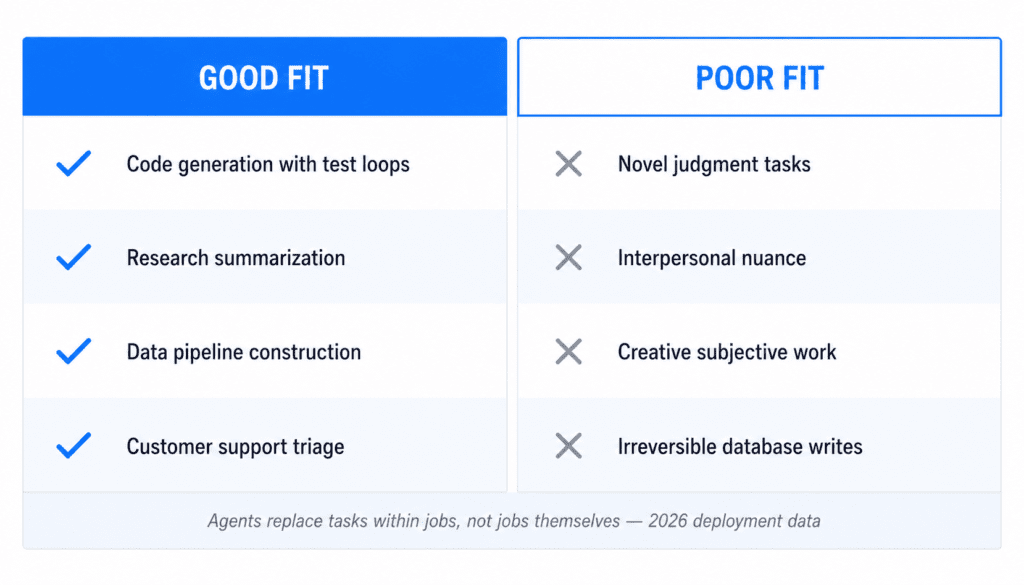
The honest framing, backed by current deployment data, is that agents are replacing tasks within jobs rather than eliminating jobs. Email triage, not email strategy. Data formatting, not data interpretation. They compound value when humans stay in the loop at the right decision points, not when humans are removed entirely.
For context on how to structure prompts to get reliable behavior from agents, the prompt engineering guide is worth reading before you write your first agent system prompt. And if you want to understand the language model underneath the agent, the LLM explainer is a good foundation.
FAQ
What’s the difference between an AI agent and a chatbot?
A chatbot takes an input and generates a response. That’s one cycle, then it waits. An AI agent takes a goal, plans steps to achieve it, executes actions using tools, observes results, and repeats until the goal is complete or it gives up. The defining difference is the loop and the ability to act on the world, not just respond to it.
What is the ReAct framework in AI agents?
ReAct, introduced by Yao et al. (2022) at Google Research and Princeton, is an agent design pattern that alternates between reasoning traces and actions. Rather than reasoning completely before acting, or acting without reasoning, the agent thinks a bit, acts, observes what happened, thinks about the result, then acts again. This interleaving prevents error propagation and allows the agent to correct itself using real-world observations rather than relying entirely on internal reasoning.
Are multi-agent systems better than single agents?
Depends entirely on the task. For short, well-scoped tasks, a single agent is simpler, cheaper, and easier to debug. Multi-agent systems help when tasks require specialization, tasks are too long for one agent’s context window, or when different subtasks need different tools or roles. The overhead of coordination, token cost, and error propagation between agents means multi-agent architectures should be a considered choice, not a default.
There’s one thing I genuinely don’t have a satisfying answer for: why do some agents perform dramatically better on tasks outside their stated scope than on tasks they were explicitly designed for? You’ll tune an agent for research summarization and it’ll turn out to be remarkably good at debugging code, which wasn’t in its profile at all. The theory of what agents are optimizing for doesn’t predict this kind of spillover. Worth watching as interpretability research catches up to what agents are actually doing.
Citations
[1] Yao, S., Zhao, J., Yu, D., Du, N., Shafran, I., Narasimhan, K., & Cao, Y. (2023). ReAct: Synergizing Reasoning and Acting in Language Models. ICLR 2023. https://arxiv.org/abs/2210.03629
[2] Wang, L., Ma, C., Feng, X., Zhang, Z., Yang, H., Zhang, J., Chen, Z., Tang, J., Chen, X., Lin, Y., et al. (2024). A survey on large language model based autonomous agents. Frontiers of Computer Science, 18(6), 186345. https://doi.org/10.1007/s11704-024-40231-1
[3] Wu, Q., Bansal, G., Zhang, J., Wu, Y., Zhang, S., Zhu, E., Li, B., Jiang, L., Zhang, X., & Wang, C. (2023). AutoGen: Enabling Next-Gen LLM Applications via Multi-Agent Conversation Framework. arXiv:2308.08155. https://arxiv.org/abs/2308.08155