AI Hallucination: Why Language Models Confidently Make Things Up
Ask a state-of-the-art language model — one with hundreds of billions of parameters — for a simple birthday. Ask it three times. You’ll likely get three different wrong answers, each delivered with complete confidence, even if you specifically told it to only respond when certain.
This is the AI hallucination problem. And the reason it persists in 2026, across the best models in the world, is not what most people assume.
It isn’t dirty training data. It isn’t a bug developers can patch out. A paper published in Nature in April 2026 and a separate analysis from researchers at OpenAI and Georgia Tech have now established something uncomfortable: hallucination is partly a mathematical consequence of how language models are trained and evaluated. Even with perfect, error-free training data, certain categories of facts would still produce unavoidable errors. The problem runs deeper than anyone who’s ever said “we just need better data” realized.
Here’s what’s actually happening.
Table of Contents
What AI Hallucination Actually Is
Hallucination in a large language model refers to output that is fluent, confident, and syntactically correct, but factually wrong or entirely fabricated.
Definition: Hallucination in large language models is the generation of content that is linguistically coherent and plausible-sounding but factually inaccurate, logically inconsistent, or unsupported by any external evidence. It’s not random noise. The output looks like something a knowledgeable person might say. That’s precisely what makes it dangerous.
Researchers distinguish between two types. Intrinsic hallucination is when the model contradicts information it was explicitly given — you provide a document, ask for a summary, and the summary adds details that don’t exist in the original. Extrinsic hallucination is when the model generates facts that contradict external reality: invented citations, fabricated court rulings, nonexistent events. Both are well-documented. In legal research, hallucination rates for case citation generation have been measured between 58% and 88% depending on the system tested.
The phenomenon is sometimes called confabulation, borrowing a term from neurology where patients with certain memory conditions generate plausible false memories without knowing they’re doing so. The analogy is imperfect but useful: the model isn’t lying. It genuinely has no internal signal that what it’s generating is wrong.
Why Do Language Models Hallucinate: The Training Objective Problem
Why do language models hallucinate? Most explanations stop at “bad training data.” The real answer is more structural than that.
Language models are trained to predict the next token, which means they’re optimizing for producing text that statistically resembles the patterns in their training corpus. They’re not learning to verify facts. They’re learning the shape of human language, and facts are swept along in that process.
Research from Kalai, Nachum, Vempala, and Zhang (2025) — researchers at OpenAI and Georgia Tech — frames this precisely. They recast the hallucination problem as a binary classification question: at every generation step, the model is implicitly asking “is this a valid output?”
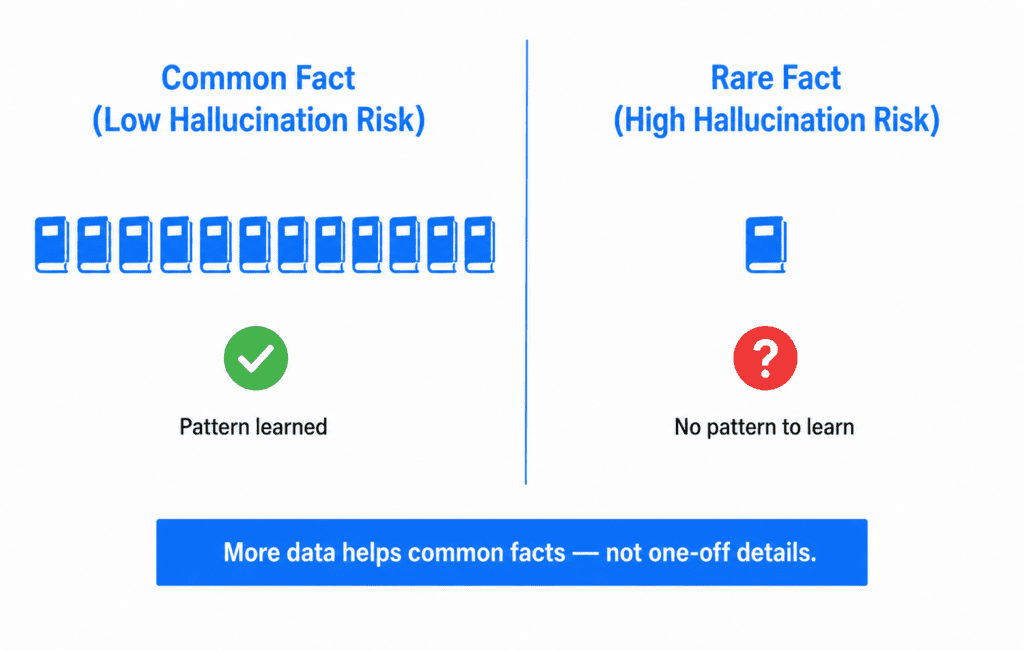
For concepts with strong, recurring patterns in training — grammar, spelling, common phrasing — the model can learn reliable classifiers. The error rate is low. But for facts that appear only once or twice in an entire training corpus — a specific person’s birthday, an obscure historical detail, a one-off statistic — no pattern exists for the model to learn from. There is no signal to generalize. The model produces a plausible-sounding answer because that is what it is optimized to do, and it is wrong because it cannot be anything other than wrong for that type of fact.
The implication is worth sitting with: if 20% of birthday-type facts appear only once across the entire pretraining dataset, you should expect the model to hallucinate on at least 20% of birthday-type questions. More data helps with commonly repeated facts. It doesn’t help with inherently rare, one-off details.
The architecture processes tokens from left to right, without the ability to look ahead or verify coherence globally. And because of a training strategy called teacher forcing, the model is always trained on perfectly correct preceding context — but at inference time, it generates each token based on its own previous output. An early wrong token cascades into more wrong tokens, and the model has no mechanism to catch or reverse that drift.
To understand how this fits into the broader picture of how language models work, the how large language models work post covers the training architecture in detail, including why next-token prediction sits at the center of almost everything.
The Incentive Problem: Why Hallucination Survives Post-Training
Post-training — the phase where models are refined using reinforcement learning from human feedback and similar techniques — is often presented as the solution to hallucination. It isn’t a complete one.
The reason hallucination in large language models persists after post-training is that the evaluation metrics used to train and benchmark these models actively reward it.
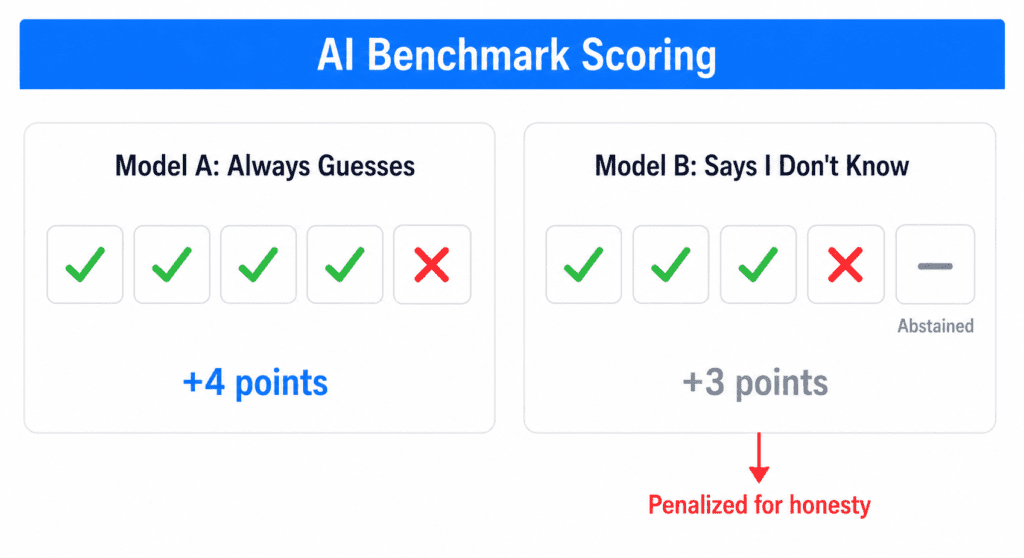
Zhang et al.’s study, published in Nature in 2026, makes this case precisely. Most language model benchmarks use accuracy as the headline metric. Accuracy scores a correct answer as 1 and anything else — including “I don’t know” — as 0. This means a model that always guesses outperforms a model that abstains when uncertain. The incentive structure doesn’t just fail to penalize hallucination; it directly rewards the behavior that produces it.
Think of it like an exam designed with no penalty for wrong answers. A student who writes “September 30” when asked a date they don’t know will score higher than a student who leaves it blank. Language models are always in this exam mode. They’ve been optimized to be good test-takers in an environment where expressing uncertainty costs points. The result is a model that has learned to bluff, not because it was trained to be deceptive, but because every signal during training told it that confident answers outperform honest ones.
This is why simply adding more RLHF or fine-tuning on “don’t hallucinate” examples doesn’t fully resolve the problem. The underlying evaluation incentives remain misaligned. Until benchmarks explicitly penalize unwarranted confidence and reward calibrated uncertainty — actually rewarding the model for saying “I don’t know” when it doesn’t know — post-training can only partially compensate for what pretraining creates. And for calibration to improve, the model needs to build better uncertainty signals: the ability to distinguish what it actually knows from what it can only pattern-match.
The Two Kinds of Hallucination You’ll Actually Encounter
Not all hallucinations have the same source, and that distinction matters enormously when you’re trying to do something about them.
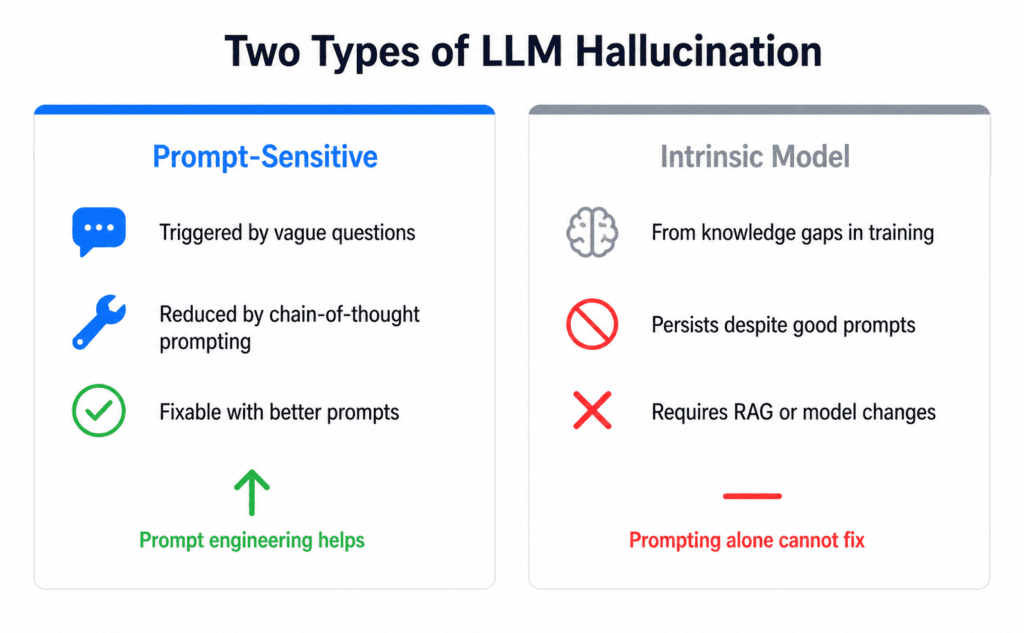
A 2025 study from the Japan Advanced Institute of Science and Technology ran controlled experiments across state-of-the-art models — GPT-4, LLaMA 2, DeepSeek, and others — and introduced a framework for separating two distinct causes. They measured Prompt Sensitivity, the extent to which hallucination varies when you change how you ask the question, and Model Variability, the degree to which hallucination persists regardless of prompt quality. These aren’t the same thing.
Prompt-sensitive hallucinations respond to better prompting. Vague or ambiguous questions produce more of them. Structured prompts — particularly chain-of-thought prompting, where you ask the model to reason step-by-step before answering — significantly reduce this category. The model wasn’t fundamentally wrong; it needed better instructions to activate the reasoning pathways it already had.
Intrinsic model hallucinations are different. They persist even with optimal prompting. These arise from genuine gaps in the model’s knowledge, from the statistical limitations of one-off facts described above, or from architectural constraints that better prompting cannot overcome. Throwing chain-of-thought at an intrinsic knowledge gap doesn’t fill the gap. It just produces more confidently-worded reasoning that leads to the same wrong conclusion.
Knowing which type you’re dealing with determines what kind of fix to reach for. If hallucinations change when you change the prompt, invest in prompt engineering. If they don’t, you need a different strategy — either grounding the model in external information or accepting the limitation.
How to Reduce AI Hallucination: What the Research Actually Supports
How to reduce AI hallucination is the question most practitioners are really asking. The research is clear on one thing: no single technique eliminates it. Effective mitigation requires combining approaches.
Retrieval-Augmented Generation and Grounding
The most widely used and well-supported technique is Retrieval-Augmented Generation, or RAG. Instead of relying on what the model learned during training, RAG pulls relevant documents at query time and gives the model specific grounding material to base its answer on. The model is no longer guessing what a fact might be; it’s being shown the fact and asked to reason about it.
RAG directly addresses the extrinsic hallucination problem. If the model is anchored to a retrieved document, it can’t easily invent information that isn’t there — though it can still misread, over-generalize, or draw wrong inferences from the retrieved content. RAG doesn’t eliminate hallucination; it significantly constrains its surface area. For a detailed explanation of how RAG works in practice, the retrieval-augmented generation post covers chunking, retrieval, and grounding in depth. The vector database explained post is useful context for understanding the search infrastructure RAG relies on.
Prompt-Based Mitigation
Chain-of-thought prompting, as the Frontiers study showed, meaningfully reduces prompt-sensitive hallucinations. Breaking a question into intermediate reasoning steps forces the model to make its logic visible, which creates checkpoints where errors can be caught before they propagate. System-level instructions — telling a model to refuse questions it’s uncertain about, to cite sources explicitly, or to flag when it’s reasoning from inference rather than known fact — shift default tendencies without fundamentally changing the model’s behavior.
The caveat: no system prompt overrides the model’s trained statistical tendencies. A model that was optimized to guess will still be pulled toward guessing. Prompt engineering contains the damage; it doesn’t remove the underlying pressure. The prompt engineering guide covers which techniques actually work and which are mostly wishful thinking.
Fine-Tuning and Model-Centric Approaches
For teams deploying language models in specialized domains, fine-tuning on high-quality, domain-specific data can improve factual reliability within that domain. The tradeoff is that fine-tuning on narrow data can increase hallucination outside it. Fine-tuning versus prompt engineering explores when each approach is the right call and what you’re actually trading off in each direction.
A more fundamental approach — what researchers call model-centric mitigation — involves modifying training objectives to reward calibrated uncertainty rather than confident answers. This is the direction the Zhang et al. paper specifically advocates: changing how benchmarks score abstention so that “I don’t know” is treated as a success when appropriate rather than a failure. As of mid-2026, this remains an active research area rather than standard practice.
LLM Factuality and Calibration as a Design Goal
The emerging framing in serious AI research is shifting toward LLM factuality and calibration as explicit system requirements, not afterthoughts. A well-calibrated model is one where expressed confidence tracks actual accuracy: when it says it’s 90% sure, it’s right about 90% of the time.
Current models are noticeably miscalibrated in the wrong direction. A 2025 analysis found that models use more confident language when hallucinating than when stating actual facts, with phrases like “certainly” and “without a doubt” appearing more frequently in wrong answers. The model is most confident when it is most wrong. Improving calibration means training models to accurately represent their own uncertainty, and then surfacing that uncertainty in the interface so users can act on it.
What This Means If You’re Building With Language Models
The practical upshot of all of this research is uncomfortable for anyone building applications on top of language models.
You cannot trust confidence as a signal. The fluency and certainty with which a model delivers an answer tells you nothing about whether that answer is correct. A hallucinated citation sounds exactly like a real one. A fabricated date is grammatically identical to a real date. Users who can’t distinguish confident hallucinations from confident facts — which is most users — are vulnerable to acting on wrong information.
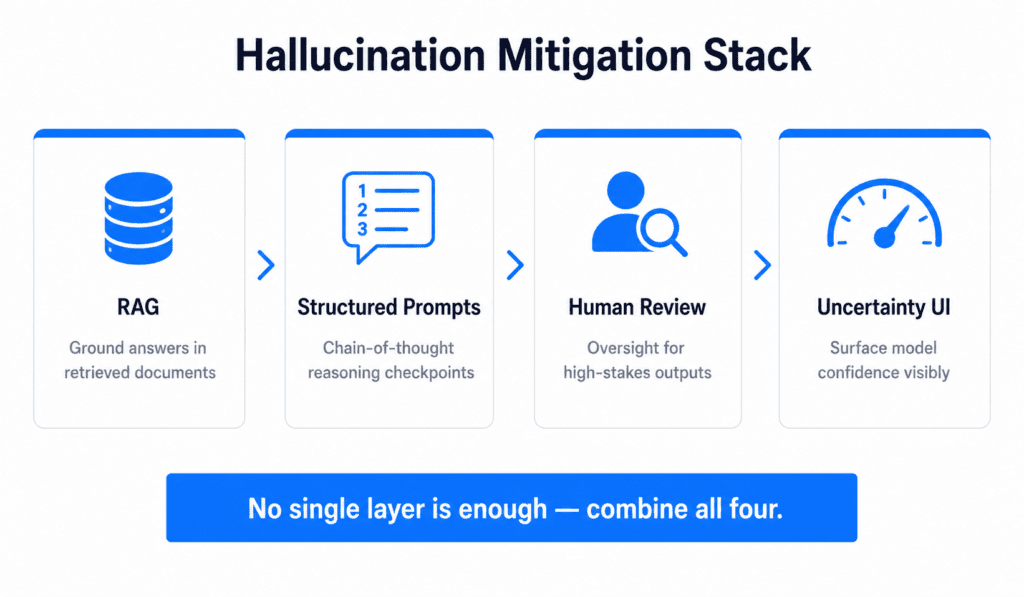
The mitigation stack worth building: RAG for factual grounding in any domain where accuracy matters, structured prompts that create reasoning checkpoints rather than open-ended generation, human review for high-stakes outputs, and explicit uncertainty surfacing in the user interface so that “I’m not certain” is visible rather than buried.
And the hardest part: accepting that for certain categories of queries — one-off facts, highly specific details, real-time information, domain expertise the model wasn’t trained on — the problem isn’t solvable with clever prompting. The architecture has mathematical limits for those cases. Building around them is more honest than pretending they don’t exist.
FAQ
What is AI hallucination?
AI hallucination is when a language model generates output that sounds fluent and confident but is factually incorrect or entirely fabricated. The model produces plausible-sounding text because that’s what it’s optimized for, not because it has verified the claim. It has no internal mechanism for checking whether what it generates is true.
Why do language models hallucinate even with good training data?
Research published in 2025 and 2026 shows that hallucination is partly a mathematical inevitability of the training objective. For facts that appear rarely or only once in training data — specific dates, names, one-off details — the model has no pattern to generalize from. It produces a plausible answer because that’s what next-token prediction does. Clean data reduces some hallucinations but cannot eliminate this category. Additionally, accuracy-based evaluation metrics reward confident guessing over admitting uncertainty, which creates incentives that push models toward hallucinating even after post-training.
Does RAG eliminate AI hallucination?
No. Retrieval-Augmented Generation significantly reduces hallucination by grounding model responses in retrieved documents, but the model can still misread, over-generalize, or draw incorrect inferences from the source material. RAG is one of the most effective mitigations currently available; it doesn’t make the problem disappear. Combining RAG with structured prompting and human review produces better results than any single approach alone.
How do you detect hallucination in model outputs?
No single detection method works in all cases. Retrieval-based detection checks model claims against external knowledge sources and works well for factual hallucinations but is sensitive to source quality. Uncertainty-based detection looks at the model’s internal confidence signals, but fails when the model is confidently wrong. Self-consistency checking runs multiple generations and flags disagreements between them. The most robust approach combines multiple detection strategies and accepts that some hallucinations will always slip through.
Is hallucination getting better in newer models?
Yes, but not as fast as the headline accuracy improvements suggest. Newer reasoning models sometimes show higher hallucination rates on factual benchmarks despite scoring better on other tasks. The best frontier models have achieved sub-1% hallucination rates on specific grounded summarization tasks, but on open-ended factual questions, average rates remain around 9% across major models. The structural causes described above have not been fully solved in any current system.
Citations
[1] Kalai, A. T., Nachum, O., Vempala, S. S., & Zhang, E. (2025). Why language models hallucinate. arXiv:2509.04664. OpenAI & Georgia Tech. https://arxiv.org/abs/2509.04664
[2] Zhang, E., et al. (2026). Evaluating large language models for accuracy incentivizes hallucinations. Nature, 653(8116), 1047–1051. https://doi.org/10.1038/s41586-026-10549-w
[3] Alansari, A., & Luqman, H. (2025). Large language models hallucination: A comprehensive survey. arXiv:2510.06265v2. King Fahd University of Petroleum and Minerals. https://arxiv.org/abs/2510.06265
[4] Dang, A.-H., Tran, V., & Nguyen, L.-M. (2025). Survey and analysis of hallucinations in large language models: Attribution to prompting strategies or model behavior. Frontiers in Artificial Intelligence, 8, 1622292. https://doi.org/10.3389/frai.2025.1622292